
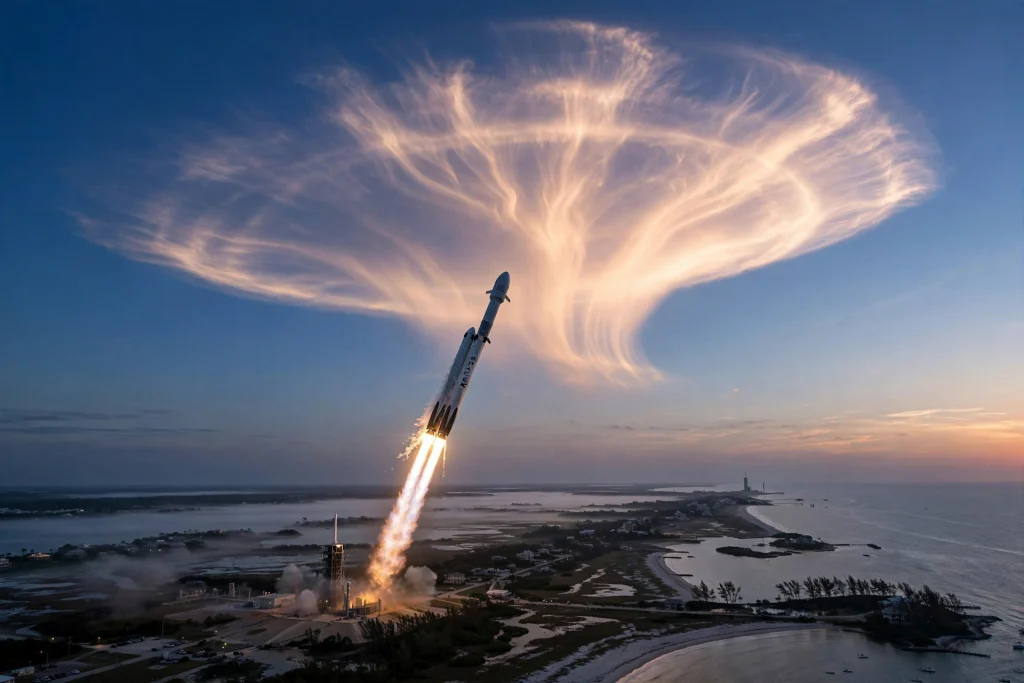
Early risers along the United States east coast were treated to an unusual sight this week when a SpaceX rocket launch painted a glowing, jellyfish-shaped cloud across the dawn sky. Photos shared from Florida to the mid-Atlantic showed a bright plume expanding high above the horizon, its tentacle-like trails lit by sunlight while the ground below was still in twilight. The spectacle, widely reported after the launch, is known among astronomers as a space jellyfish, and it remains one of the most striking side effects of modern rocketry.
What Creates a Space Jellyfish?
The effect happens when a rocket climbs into the upper atmosphere shortly before sunrise or just after sunset. At ground level it may still look dark, but at high altitude the exhaust plume is already catching direct sunlight. That contrast makes the expanding gases glow against a deep blue sky. As the plume spreads, it takes on a rounded head with trailing streams underneath, closely resembling a jellyfish drifting through water. Reports collected by The Guardian described viewers watching the cloud grow and change shape for several minutes before it faded.
Unlike an ordinary aircraft contrail, a launch plume expands in near-vacuum conditions. Gases that would stay in a narrow stream lower down can billow outward dramatically, creating the wide, translucent dome that makes the phenomenon so photogenic. Weather helps too: clear skies and calm upper winds on the morning of a launch allow the structure to hold together instead of being torn apart quickly.
Why the East Coast Sees It So Often
Florida’s Space Coast has become one of the busiest launch sites in the world, and dawn or dusk missions from Cape Canaveral are perfectly placed for east coast viewing. Depending on the trajectory, the glowing plume can be visible hundreds of miles away, surprising commuters and dog walkers far from the launch pad. Readers who enjoy slower, more deliberate journeys, as explored in our piece on slow travel and longer trips in 2026, often say these brief celestial detours are a reminder to look up more often.
Launch providers publish schedules in advance, but the jellyfish effect depends on timing. A launch in full daylight produces a fairly ordinary white trail, and a launch in deep night may be bright at the base but lack the high-altitude sunlight that makes the plume glow. The sweet spot is a window of roughly an hour around sunrise and sunset, which is why the most shared images tend to come from early morning missions.
How to Watch the Next One
If you want to catch a future display, start by checking upcoming launch schedules and picking a mission timed near dawn or dusk. Find a spot with a clear view towards the launch site, ideally away from bright street lights, and arrive a few minutes early. The main engine burn is brief, but the expanding plume can remain visible for five to ten minutes afterwards. A phone camera on night mode can capture surprisingly good images, though a short exposure usually preserves the colours better than a long one.
It also helps to manage expectations. Cloud cover, a delayed launch or a different flight path can all spoil the show, in the same way that travellers learn to troubleshoot small setbacks, a theme we covered when handling an app that will not install. Flexibility is part of the experience, and even a scrubbed launch often means another attempt within days.
More Than a Pretty Picture
Beyond its beauty, each launch represents the growing cadence of commercial spaceflight: satellite deployments, crew missions and technology tests now leave Florida at a pace that would have been unthinkable a decade ago. Astronomers at NASA and elsewhere continue to study how high-altitude plumes behave, while photographers treat every dawn mission as a chance to document a fleeting piece of sky art.
For the thousands of people who stopped, looked up and shared their pictures this week, the jellyfish cloud was a short, shared moment of wonder. With launch schedules remaining busy through the rest of 2026, it is unlikely to be the last one the east coast sees this year.
