
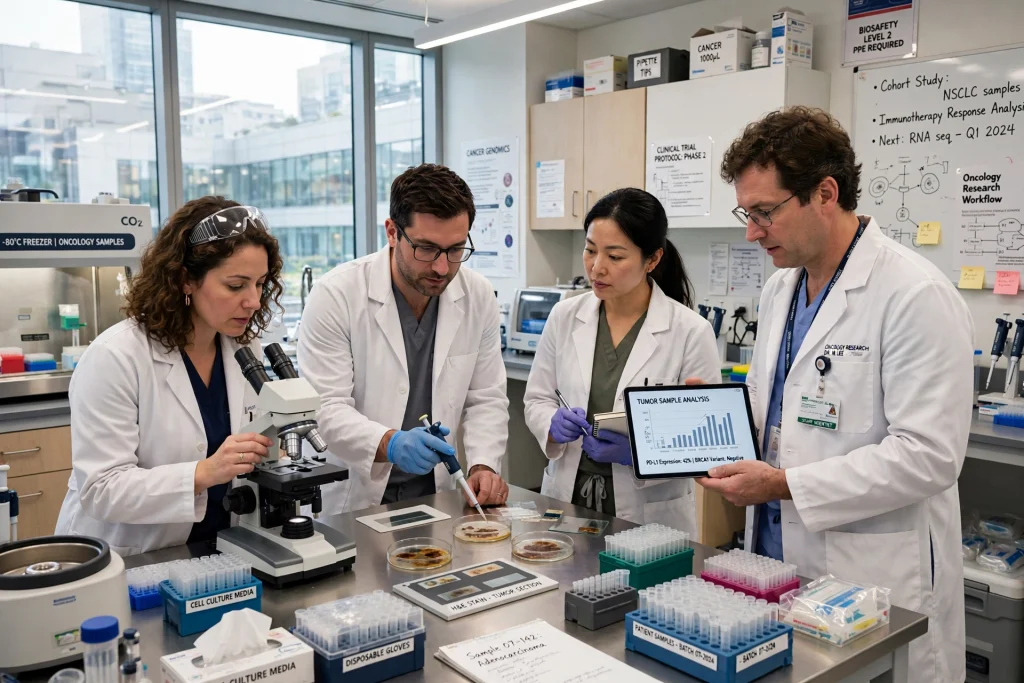
The road to a new cancer treatment is long, and this week it passed one of its earliest markers. A phase 1 trial in Nature Medicine tested NeoVax, a vaccine personalised to the neoantigens in each patient’s tumour, together with nivolumab in platinum-sensitive ovarian cancer. The verdict was narrow and genuinely useful: the approach was feasible, and its safety profile was acceptable. Anyone mapping the journey of personalised immunotherapy should mark the point accurately — not the destination, not a shortcut, but a confirmed staging post from which larger, decisive trials can be planned.
Feasible and tolerable: the two findings
Published in Nature Medicine, the phase 1 trial of NeoVax plus nivolumab in platinum-sensitive ovarian cancer reports two findings, neither of which should be inflated. First, a fully personalised neoantigen vaccine could be produced and administered for the patients enrolled. Second, the combination’s safety profile was acceptable at this early stage. Phase 1 research exists to establish exactly those points before anyone asks whether a treatment improves survival, and on those terms the study did its job.
From biopsy to bespoke vaccine
Each vaccine began with the patient’s own tumour. Sequencing identified mutations; computational tools predicted which neoantigens — the distinctive fragments those mutations create — were most likely to provoke an immune response; a vaccine was then manufactured to order. Add nivolumab, an antibody that prevents cancer from switching off immune cells through PD-1, and the logic becomes clear: present the targets, remove the brakes. The operational achievement should not be understated, because personalised manufacturing at clinical speed remains one of immunotherapy’s biggest practical challenges. Readers can explore further background from Nature, which provides additional context on the research and the institutions involved.
Milestones on a long route
Drug development fails most often at the unglamorous stages: treatments that cannot be manufactured consistently, schedules patients cannot tolerate, combinations whose side effects stack up. By clearing feasibility and early safety in a disease as demanding as ovarian cancer, the NeoVax combination avoids several of those early exits. The route ahead is still formidable — randomised trials, survival endpoints, manufacturing scale-up — but routes are how progress happens in medicine: sequentially, with each stage earning the next, rather than by leaps announced in headlines.
Why researchers keep returning to ovarian cancer
Ovarian cancer has resisted immunotherapy more stubbornly than many other tumours, despite the clear logic of immune-based treatment. It is commonly advanced at diagnosis, and recurrence after platinum chemotherapy is a familiar, distressing pattern; platinum-sensitive patients, whose cancers still respond to that chemotherapy, are a group where new maintenance ideas are actively sought. A vaccine tailored to tumour mutations offers a way to make a relatively ‘cold’ cancer more visible to the immune system, which is precisely the hypothesis larger trials would need to test. For more on a related subject, see our earlier coverage: our earlier analysis of glucose monitoring trials.
Keeping the news in proportion
Early-stage success stories in oncology are common; confirmed breakthroughs are rarer, and the distance between them is measured in years of further trials. This study cannot tell us whether NeoVax helps women live longer or better, whether benefits would outweigh burdens, or whether health systems could deliver it widely. Its contribution is narrower and still valuable: a complex personalised strategy proved deliverable alongside standard immunotherapy. Anyone affected by ovarian cancer should discuss trial participation with their specialist rather than drawing conclusions from headlines, including this one.
For patients and families, the sensible response is informed patience: note the milestone, ask oncologists about trial eligibility where relevant, and resist anyone selling certainty. This study offers something more durable than certainty — a workable next step.
The cost and access question
Even optimistic readings of this research must confront delivery. A vaccine designed for one patient cannot be mass-produced like a conventional drug, so its cost per person is inevitably high at first, and the specialist centres able to sequence, manufacture and administer it are few. Researchers argue that processes tend to become faster and cheaper as they are repeated, and the feasibility shown here is part of that learning curve. Whether health systems could fund such treatment widely, if benefit is eventually proven, is a legitimate public question — and one best asked early, while the science is still developing.
