

Image: Heng Films / Wikimedia Commons (CC0)
Working from home has obvious perks: no commute, lower overhead and the freedom to start the day in comfortable clothes. For self-employed people and small business owners in the United States, it can also bring a tax benefit in the form of the home office deduction. Claimed correctly, it lets you deduct a portion of the costs of the home you already live in. Claimed carelessly, it can trigger questions you would rather not answer.
The deduction is not complicated once you understand its building blocks, but the details matter. Who qualifies, how the space is used, which method you choose and what records you keep all affect whether the deduction holds up. The infographic below turns those building blocks into a seven-point checklist. The sections that follow walk through each item so you can decide whether the deduction fits your situation and what to discuss with your tax professional.
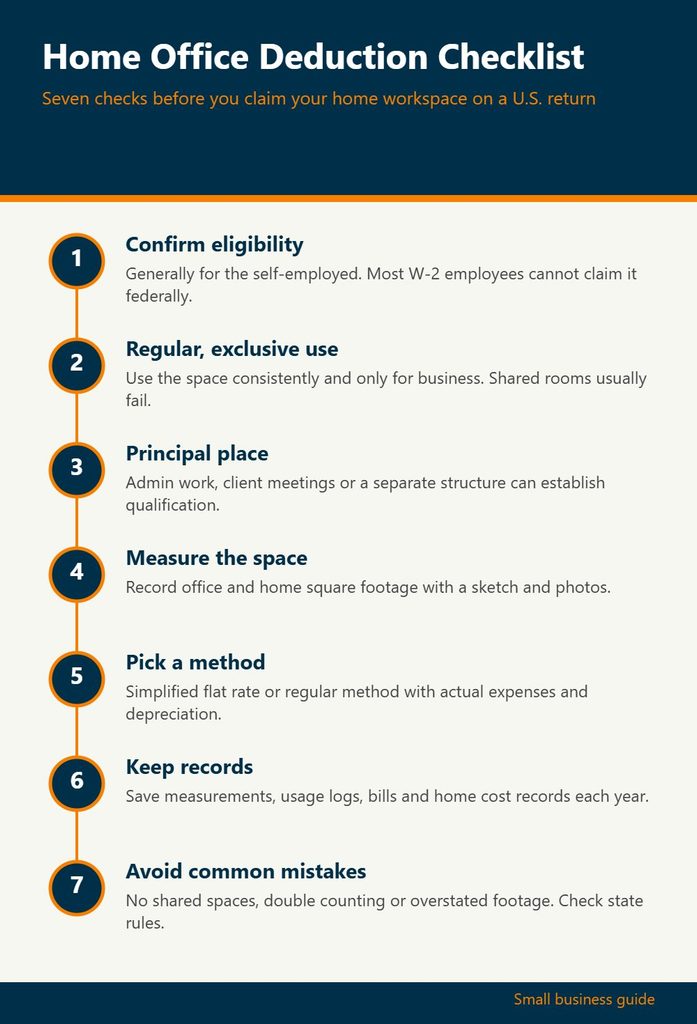
This article offers general information, not tax advice. Tax rules change and individual situations differ, so confirm the details with a qualified accountant or enrolled agent, and check current IRS guidance before filing.
1. Confirm You Are Eligible to Claim It
The first question is not about your office at all. It is about how you earn your income. The home office deduction is generally available to people who are self-employed, such as sole proprietors, independent contractors, freelancers and single-member LLC owners who report business income on Schedule C. Partners and owners of other entity types may have their own routes for recovering home office costs, often through reimbursement arrangements, so the mechanics differ.
Employees who receive a W-2 are in a different position. Under current federal rules, most employees cannot deduct home office expenses on their federal return even if they work from home full time. Some states have their own rules, so it is worth checking. If you have both a W-2 job and a side business, you may be able to claim the deduction for the space used for your side business, provided it meets the other tests.
2. Pass the Regular and Exclusive Use Test
This is the test that trips up the most people. To qualify, the space must generally be used regularly and exclusively for your business.
- Regular use means you use the space for business on a consistent basis, not just occasionally.
- Exclusive use means the space is used only for business. A spare bedroom that serves as your office during the day and a guest room on weekends does not meet the test. Neither does the dining table where you work and the family eats dinner.
The space does not have to be a separate room. A clearly defined area of a room can qualify, as long as that area is used only for business. Some owners use furniture, a room divider or even tape on the floor to mark the boundary and make it easy to measure and explain.
There are limited exceptions to the exclusive use requirement. Space used to store inventory or product samples can qualify under certain conditions, and so can space used for a licensed daycare business. If either applies to you, review the rules carefully with your tax adviser.
3. Establish It as Your Principal Place of Business
Beyond regular and exclusive use, the home office generally must meet one of several additional tests. The most common is that it is your principal place of business. This can be true even if you do much of your work elsewhere, as long as you use the home office for administrative or management activities and have no other fixed location where you conduct substantial amounts of those activities.
Consider a plumber who spends most of the day at customers’ homes but handles billing, scheduling and ordering supplies from a home office. The home office can still qualify as the principal place of business because there is no other fixed location for that administrative work.
Other ways to qualify include using the space regularly to meet clients or customers in the normal course of business, or using a separate structure on your property, such as a detached studio or garage workshop, exclusively and regularly for business.
4. Measure Your Space Accurately
Once you know the space qualifies, measure it. You need two numbers: the square footage of the office area and the total square footage of your home. The office percentage, calculated by dividing the first by the second, drives the regular method of calculating the deduction.
Measure carefully and record how you did it. A simple sketch with dimensions, plus a few photos showing the space set up as an office, is helpful documentation if you are ever asked to support the claim. If you move or rearrange during the year, note the dates and the new measurements.
For a deeper look at deductions that commonly apply to home-based businesses, GrowBizLab has a range of practical tax and finance guides written for self-employed owners. You can see more of those resources if you want to understand how the home office fits alongside other deductions.
5. Choose Between the Simplified and Regular Methods
The IRS offers two ways to calculate the deduction, and you can generally choose whichever works better each year.
The simplified method
The simplified method multiplies the square footage of your office by a fixed rate set by the IRS, up to a maximum square footage. For many years the rate has been five dollars per square foot for up to 300 square feet, but confirm the current figures before you file. The appeal is simplicity: there is no need to track and allocate actual home expenses, and there is no depreciation to calculate. The trade-off is that the deduction may be smaller than what you would get with the regular method, especially if your housing costs are high.
The regular method
The regular method calculates the business portion of your actual home expenses. Sole proprietors generally use Form 8829 to work through it. Expenses fall into two broad groups:
- Direct expenses apply only to the office, such as painting or repairs to that room. These are generally deductible in full.
- Indirect expenses apply to the whole home, such as mortgage interest, rent, property taxes, homeowners or renters insurance, utilities, general repairs and security. You deduct the business percentage of these.
Homeowners using the regular method also claim depreciation on the business portion of the home. That can increase the deduction now but may have tax consequences when you sell the home, because depreciation previously allowed may need to be recaptured. Ask your accountant how this applies to you before choosing.
Under the regular method, the deduction is generally limited by the income from your business, and certain unused amounts may carry forward to future years. The simplified method has its own limit and does not allow a carryforward. These details are a good reason to run the numbers both ways or have a professional do it.
6. Keep Organized Records
Whichever method you use, documentation is what makes the deduction defensible. Build a simple folder, digital or paper, for each tax year that includes:
- Your office measurements, floor plan sketch and photos.
- A short written description of how the space is used and what business activities happen there.
- Records showing regular use, such as a calendar of client meetings, project logs or time records.
- For the regular method, statements and receipts for mortgage interest or rent, property taxes, insurance, utilities and repairs.
- Records related to the purchase price and improvements of your home if you claim depreciation.
Good bookkeeping makes this much easier. If you use accounting software, create a category for home office expenses and attach receipts as they come in. Keep records for as long as your tax adviser recommends, and longer for anything related to the home’s cost basis, since it can matter years later when you sell.
7. Review Related Expenses and Common Mistakes
The home office deduction covers the space itself, but other home-based business costs may be deductible separately. Office furniture, computers, software, a dedicated business phone line and office supplies are typically handled as ordinary business expenses or depreciable equipment rather than as part of the home office calculation. Internet and phone service used for both personal and business purposes usually need to be split based on business use.
Avoid these frequent mistakes:
- Claiming a shared space. If the family uses the room, it probably fails the exclusive use test.
- Overstating the square footage. Measure honestly and keep the evidence.
- Claiming as an employee. W-2 employees generally cannot take the federal deduction.
- Deducting the same cost twice. Do not count an expense in the home office calculation and again elsewhere on your return.
- Forgetting about depreciation recapture. Using the regular method as a homeowner can affect taxes when you sell.
- Ignoring state rules. State tax treatment can differ from federal treatment.
Many owners worry that claiming the home office deduction increases the risk of an audit. The best response is not to skip a deduction you legitimately qualify for, but to make sure you meet the tests and can document them. If you would like a structured walkthrough of business deductions beyond the home office, GrowBizLab offers this helpful guide along with other tax-season resources aimed at small business owners.
Putting the Checklist Into Practice
Before tax season, take thirty minutes to work through the checklist. Confirm your eligibility, make sure the space meets the use tests, measure it, gather your expense records and decide which method you plan to use. Then bring your notes to your tax preparer, along with your questions. A prepared client saves the preparer time, and that usually translates into a smoother, less expensive filing.
If your situation changes during the year, such as moving, converting the office back into a bedroom or opening an outside location, update your records at the time rather than trying to reconstruct the details later. The home office deduction rewards owners who treat their workspace like the business asset it is. With a clearly defined space, careful measurements and organized records, you can claim what you are entitled to and file with confidence.
